

1. Evil Geniuses vs TNC
If there was ever a storyline that every Southeast asian Dota 2 fan would have been talking about this year, TNC’s journey been the one.
The Filipino team kicked off the group stages against Evil Geniuses. For Theeban ‘1437’ Siva, TNC’s captain, this was his opportunity to prove himself as a captain against America’s best.
https://www.youtube.com/watch?v=HcEjlYAs5NI
Game 1 set the tone for the series. TNC got off to an excellent start, going up to eight kills against EG’s three at 8 minutes. However, from the draft it was evident that TNC lacked any substantial teamfight.
Against EG’s Puck and Faceless Void, TNC could only hope that they were able to pick either one of these heroes off with their Batrider before the teamfight started.
However, EG managed to keep TNC’s advantage low despite giving up several early game kills. In the mid game, EG’s teamfight superiority allowed them to gain a substantial lead, winning the game as a result.
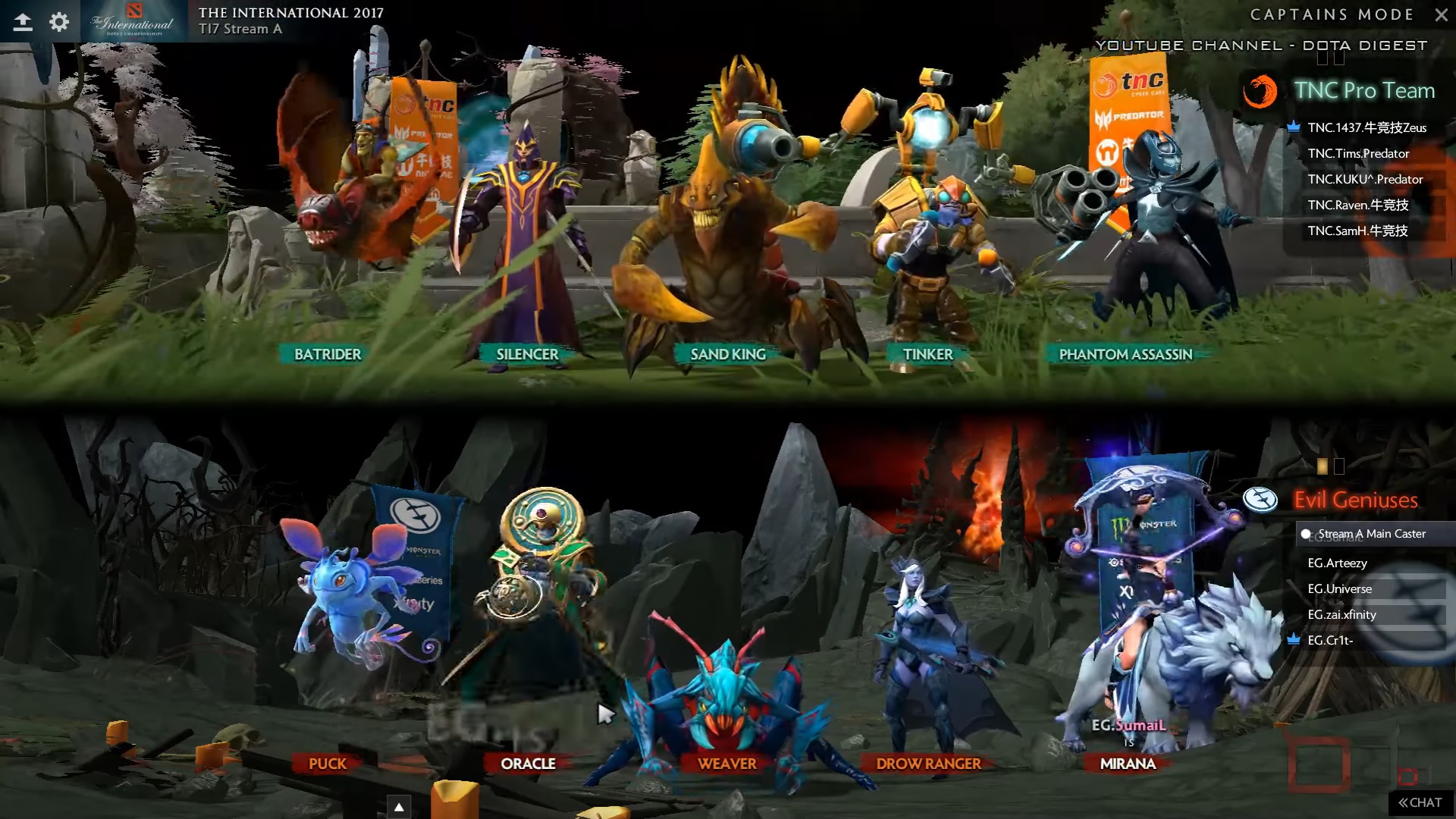
Game 2 was where 1437 redeemed himself, with TNC’s Carlo ‘Kuku’ Palad spearheading this comeback. 1437 first navigated EG’s draft trap of first pick Puck and Oracle masterfully by playing directly into the hard counters for what the two heroes did.
[Caption: Game 2’s draft was far more teamfight centric, which allowed TNC to outclass EG / Credit: Dota Digest]
Batrider, as one of the best intitators in the game, allowed TNC to play the game faster and take the pace away from EG. Silencer ensured perfect initiations against Oracle and Weaver – a typical Chinese Dota 2 strategy – but 1437’s Silencer had another use.
Silencer allowed TNC to play faster than their enemies – his ultimate effectively delaying the enemy team’s damage output by making them unable to cast spells at the start of teamfights.
This forced EG to play by TNC’s pace even in teamfights, solving game 1’s draft weakness. This adjustment allowed TNC to snowball their early game advantage into a win, eventually securing TNC’s upper bracket position in the main event.
2. OG vs Cloud 9
In what would be a relatively close series, OG vs Cloud 9 could be said to be the clash of two ideals. While OG tends towards playing the game how their captain sees it, Cloud 9 is a team where each member tries to win the game in their own way.
While OG enjoys clarity of purpose, Cloud 9 lends itself greatly to unpredictability.
In this clash, we saw the very organised OG break Cloud 9 apart in spite of the latter’s early game advantages. Each game told the same story: big early game advantages for Cloud 9, which were broken by OG’s superior teamfight execution.
Cloud 9’s current roster has only been together for 3 months compared to OG’s 11 months. During each game, we could see cohesiveness of OG stand tall against the best efforts of Cloud 9.
Caption: 4 members from OG grouped close together, compared to C9’s spread out team (see minimap) / Credit: Dota 2
Each Cloud 9 member was undoubtedly doing their best to win the game, but were much less snappy than OG when they engaged in teamfights.
For example, in game 1 when MSS initiated on the enemy, his team would often be too far back to capitalise immediately. This allowed the more organised OG to catch up and isolate MSS, and subsequently win the imbalanced teamfight 4 v 5.
Cloud 9’s inconsistency was a weakness which teams could exploit, which caused them to barely scrape into the main event.
3. Virtus.Pro vs OG
This was the unofficial Kiev Majors rematch. The games even played out the same way, except when Virtus.Pro (VP) got the advantage, they ran away with it and left OG in the dust.
https://www.youtube.com/watch?v=-mzVTjmWQ_U
Game 1 was a lesson in laning setups and support movements. In the first 4 minutes, Ilya “lil” Ilyuk’s Nightstalker controlled the game for VP as he set up 3 kills on OG’s mid laner Anathan ‘ana’ Pham. This allowed VP’s mid laner, Vladimir ‘No[o]ne’ Minenko to snowball and eventually secure further kills in lane with his level advantage.
Lil continued to make strategic plays, performing an effective feint at 15 minutes by showing himself on the bottom lane while his team was wrapping around to backstab OG’s top lane tower push. As VP’s heroes ambushed OG’s backline, lil joined the fight and secured an additional kill for his team.
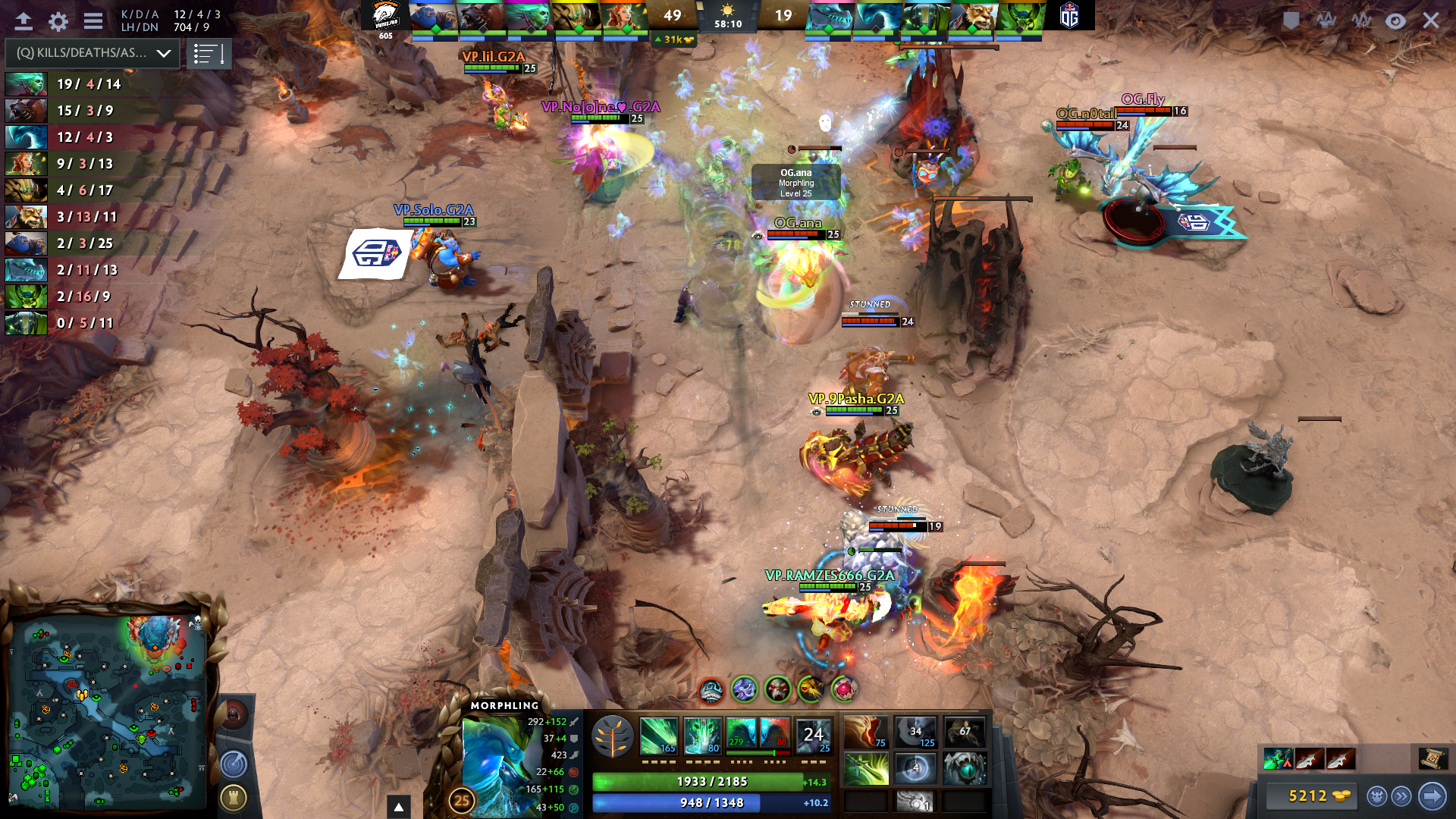
Game 2 was the ana show. Just like in Game 5 of VP vs OG at the Kiev Major, ana held the game together for his team, staying at the top of the networth board as Morphling throughout the game.
Caption: With ana as the sole damage dealer for OG, he soon found himself overwhelmed by VP’s trio. /Credit: Dota 2
Against VP’s midgame-centric draft, ana’s Morphling was in a race to outscale VP’s heroes. With both Ursa and Death Prophet, VP was committed to the mid game push strategy – which put VP on the clock.
What followed made TI7 history. For over 40 minutes, ana held OG’s fort together, dealing over 87.6k damage for his team. Repeatedly, VP heroes would try to siege the OG high ground only to take several quick casualties and be forced to retreat to preserve their advantage.
However, even though VP was still on a timer, there was a major difference compared to Kiev Major: they only had ana to worry about and thus managed to consistently outfarm OG.
This made all the difference in allowing VP to recover mentally from ana’s repeated defences as they ever only had to worry about one member from OG. VP’s victory here heralded one of the most dominant performances by a CIS team at any TI.
Notable battlepass predictions set during Game 2: Most deaths – N0tail: 20 deaths. Most kill total in a game – 88 and longest game ever: 60+ minutes.
Catch all the action at www.twitch.tv/dota2ti
Originally published on Spout360 (site now offline).